
Cooking Games Online





























What are Cooking Games?
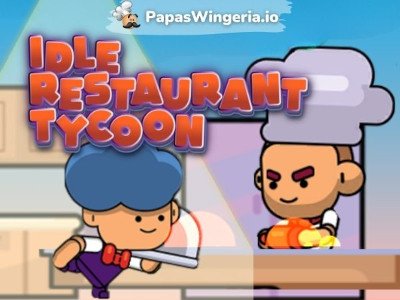
Cooking games are video games that simulate food tasks like prepping, cooking, plating. They often add service or management layers. Types range from time management to sandbox style creation and hybrids that add upgrades, recipes, or staff. Most of them are designed around cooking process, timing, and feedback. Some are cozy and creative, letting you decorate cupcakes or try world cuisines. While others are hectic, such as running a diner during the rush. But most cooking games are easy to pick up as controls are most likely simple tapping and dragging mechanics. In this article, we'll dive deep into cooking games genre, how it started, it's arcade and flash roots, psychology of cooking and the best cooking games to play online.
From Arcade Roots to Flash Era
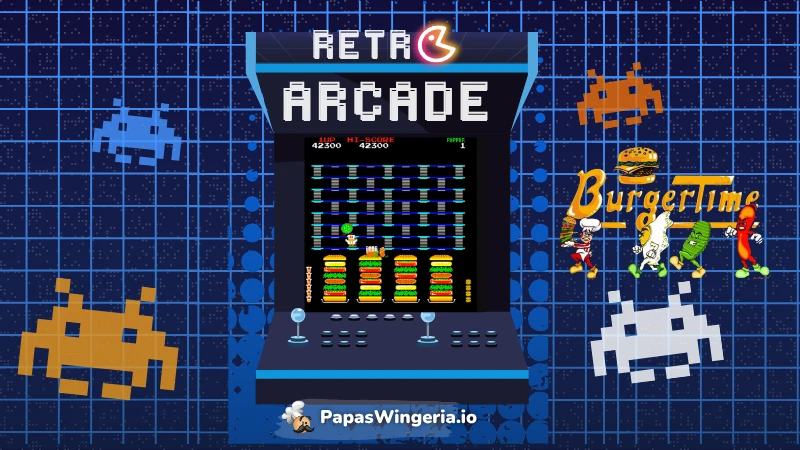
Cooking games didn’t appear out of nowhere. They trace back to the early days of arcades. One of the first big hits was BurgerTime in 1982, where players stacked burger ingredients while dodging walking hotdogs and eggs. It showed that food could be the center of a fun game. In the early 2000s, cooking games found a new home in Adobe Flash. This was when time-management titles and cooking simulations exploded online, often appearing on free game portals. Flash made it easy to design colorful, interactive games that kids could play right in a school computer lab or at home, no downloads required. Games like the Papa Louie’s series became staples, mixing cooking with customer service and upgrades. They turned what started as novelty arcade play into a recognizable online mini genre.
HTML5 Revolution in Cooking Games

When Flash support ended in 2020, many thought it might be the end of these quick games. But, instead the shift to HTML5 sparked a revival. Unlike Flash, HTML5 runs smoothly on mobile devices and modern browsers without extra plugins. This made cooking games more flexible than ever, playable on Chromebooks, phones, and tablets besides desktops. Developers converted older classics into HTML5 while also creating new ones with updated graphics and touch controls. The change basically reshaped how people accessed cooking games, making them part of a mobile-first world. So, a quick round of flipping pancakes or serving sushi could fit between classes, work breaks, or commutes. In a sense, HTML5 kept the kitchen open, allowing the genre to keep serving players long after Flash was gone.
Time Pressure vs. Relax Mode: Two Very Different Audiences

Cooking games tend to split into two very different styles, and each attracts its own kind of player. On one side, there are the time-pressure games. These are mostly, multitasking experiences where customers pile up, orders get more complicated, and the thrill comes from keeping up under stress. Games like the Papa’s series or Overcooked thrive on this rush. They are appealing to players who enjoy a challenge.
On the other side are the relax-mode games. These don’t measure success in seconds and rather choose creativity. Instead of racing to beat a clock, players can decorate a cupcake, plant herbs, or experiment with recipes at their own pace. The audience here is often looking for a cozy break, something calm to fill a few minutes without the pressure of losing points or failing customers.
This contrast shows just how flexible food gaming has become. It can be both hectic and soothing, depending on what the player wants. And in recent years, it’s the second approach, the slow and creative one, that has really caught fire online.
Future of Food Gaming: Cozy and Creative
By 2023, the cozy gaming trend had taken over social platforms. Cozy gamers were beyond the sole experience of playing. They turned the whole concept of gaming into an entire cozy experience around them. Setups often included pastel-colored lights, warm blankets, hot drinks, and soft background music. This has turned cozy gaming into a kind of ritual for comfort. The games chosen reflected this mood: slow-paced games with little to no stress mechanics. Popular picks included cooking games, café and restaurant simulators, as well as farming-life hits like Animal Crossing and Stardew Valley. Many gamers recorded themselves brewing tea in Cozy Animal Cafe, decorating pixel cafés in Toka World Restaurant, or arranging in-game meals. Then they shared these calm play sessions on TikTok, YouTube, and Twitch. Often, the videos were paired with ASMR style soothing sounds, soft commentary, and a relaxing aesthetic.
Food games fit perfectly into this shift. Their focus on simple routines, creativity, and satisfying visuals makes them natural cozy companions. Looking forward, the future of food gaming seems set to move further in this direction. We can expect fewer high-pressure timers and more games built around plate decoration, ingredient growing, or sandbox recipe experiments. In short, food games are evolving from quick time-management challenges into small, comforting spaces that blend play, creativity, and relaxation.
The Psychology of Cooking Games: Why Serving Food Feels Good
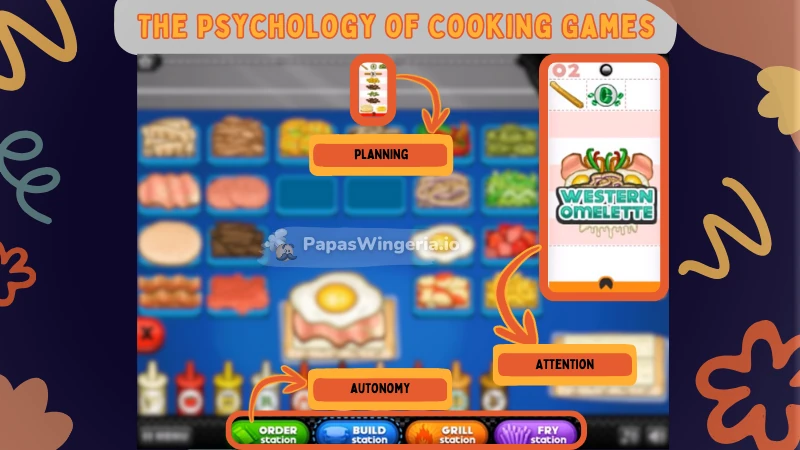
Cooking games might look simple on the surface. But beneath something deeper lies. These games tap into very real psychological needs: the satisfaction of completing tasks, the creativity of making something from scratch, and even the comfort of routine. It’s no surprise that researchers and psychologists have started to look at cooking, both real and digital, as a meaningful human activity with emotional and cognitive impact.
A fascinating study published in Frontiers in Aging Neuroscience explored how a serious game called “Kitchen and Cooking” was used with elderly people living with mild cognitive impairment and Alzheimer’s disease. The game, played on tablets, asked participants to complete simple cooking scenarios like preparing pizza or yogurt cake. Over four weeks, patients reported that the game was enjoyable, motivating, and not tiring, and researchers found it could even help train planning skills, attention, and motor functions. Interestingly, even patients who usually struggled with apathy engaged positively and played more than expected. This research highlights how cooking games aren’t just fun distractions—they can also provide meaningful cognitive stimulation and support well-being in real life 【Frontiers in Aging Neuroscience, 2015】.
What makes this especially interesting is how closely it connects to the broader psychology of cooking itself. In his book A Psychology of Food, Cooks, and Cooking, David Livert looks at cooking not just as a household task but as a deeply human activity shaped by motivation, learning, and identity. He explores how people develop cooking skills, why some find joy in the kitchen while others avoid it, and how time pressure, creativity, and confidence all influence the way we cook. Cooking, as Livert points out, isn’t only about putting food on the table. It’s tied to memory, culture, and social connection, whether at home or in professional kitchens.
Seen together, the study and Livert’s insights help explain why even digital cooking experiences can feel so rewarding. Games recreate the same loops of planning, doing, and completing that real cooking provides, but in a simplified form. They give players the chance to succeed quickly, experiment creatively, and sometimes even share their “dishes” with others. This overlap between real-world psychology and virtual kitchens suggests that cooking games resonate not just because they’re playful, but because they mirror the deeper satisfactions of cooking itself 【Livert, 2023】.
Top 10 Cooking Games to Play Online
Cooking games come in all shapes and flavors. Some race against the clock, while others are slow and creative, and there are others more puzzle oriented . What ties them together is the simple joy of making food. To show the variety, we’ve gathered best cooking games that each bring something different to the table. Some teach real recipes, some test your patience, and others lean into cozy design. Together, they highlight just how wide the kitchen door is open in the world of online gaming. Plus, they are all free to play on PapasWingeria.io.
1. Papa’s Wingeria

Papa’s Wingeria is a flash classic by Flipline Studios which was released in 2012. FAst forward to today, there are only a few console games that reach it's authenticity, gameplay variety, and humorous design. The gameplay is mostly about timing, multitasking, and learning to handle small details under pressure. Many players don’t realize how much the game teaches about order flow: balancing frying, saucing, and plating all at once. It’s one of those games where tiny mistakes like overcooking by a second, snowball into bigger waiting-time penalties. The game is also loved for its rhythm, almost like a kitchen dance. It's been played by millions of players until today and definitely deserves the top spot on our list. Creators Matt and Tony did such a good job that it's no wonder we had to include several Papa's games in this list.
2. Cozy Kitchen Merge
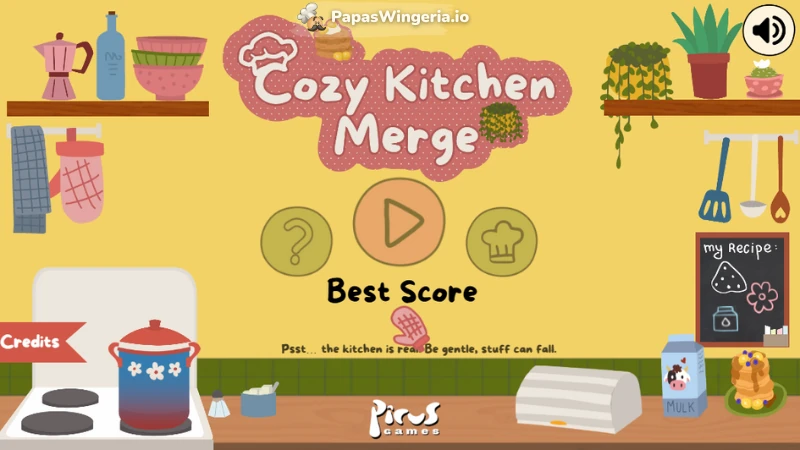
Cozy Kitchen Merge is a indie cooking puzzle game that is built on hand-drawn design that feels soft and calming. For sure, this is rare in the food game space. Instead of racing a clock, players merge ingredients to unlock recipes in a slow but layered way. The real charm lies in the cozy atmosphere like chalkboard menus, warm tones, and a casual flow that feels more like doodling in a notebook than playing a game. It highlights how cooking games don’t always need speed; sometimes they work best as quiet creative spaces. I like to play this one especially on my Ipad in quiet times to clear my mind. Thanks to a new small game studio from Europe, Pirus Games, for bringing this calming game. It was high time we had something like this.
3. Cookingdom: Cook and Relax
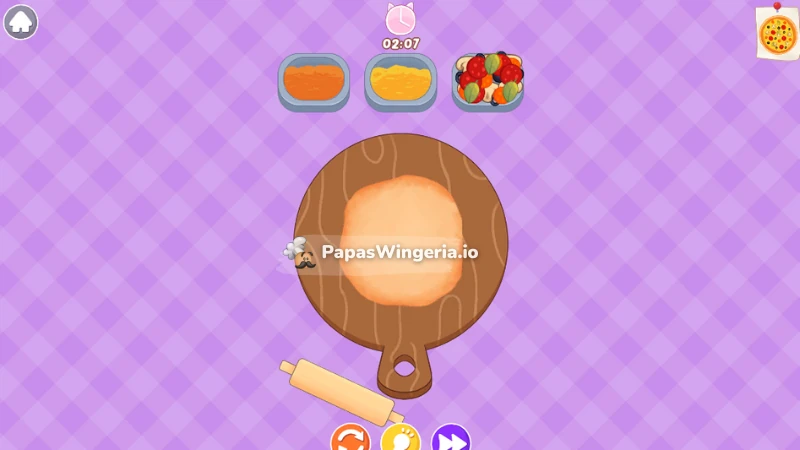
Cookingdom flips the usual cooking-game formula on its head by focusing on trial and error instead of boring pre-set steps. To make a dish, you figure out the right order of actions. Let's say you'll make a bowl of spaghetti you just cannot skip steps. Turn on the stove, put the pot on stove, add some water, and wait a while before adding the pasta. Even though this sounds simple in words, you'll be surprised how much we skip steps in other regular cooking games for the sake of simplification in game design. By playing Cookingdom, you'll learn from your mistakes. It becomes less about “beating a level” and more about experimenting. This makes it surprisingly close to how real cooking feels. It’s the kind of game that quietly teaches patience and logic while still being approachable.
4. Papa’s Freezeria
Another title from Papa Louie franchise, Freezeria is often remembered for ice cream sundaes, but what sets it apart is how it trains your eye for sequence. From layering syrups to placing toppings at exact angles, the game demands a precision that mirrors pastry work more than fast food. Unlike other Papa’s titles, the pace is deceptively calm at first. Customers lull you into comfort before the rush picks up and your station becomes a puzzle of half-finished shakes. It’s a favorite for players who like focus but don't want to sacrifice the rush either.
5. Penguin Diner
Another Flash classic Penguin Diner looks like a light-hearted restaurant game on the surface. But it’s a sharp lesson in table management. Every decision like where to seat a group, how quickly to clear tables, impacts how many customers you can serve before closing. The charm comes from how quickly players learn to read patterns, anticipating which penguin is likely to tip more or stay longer. It’s essentially a strategy game dressed up in ice and fish. The penguin theme is a pioneer in its genre inspiring lots of animal themed cooking games later.
6. Papa’s Sushiria
I have thought for so long about including a third PL game in my list. But I couldn't resist this one. Sushiria is one of the most precision-heavy cooking games of all times. Hard and delicate work of Japanese couisine is so well reflected in this game that you have to be very careful about stacking, rolling cutting. What often goes unsaid is how much the game demands planning. You can’t just react, you have to stay two steps ahead of the order board. It appeals to players who like mastering repetition until every roll looks perfect. If you count on your gaming skills, this one is your alley as it's the most diffivult game in both Papa's series and this top 10 cooking games list.
7. Pixel Burgeria
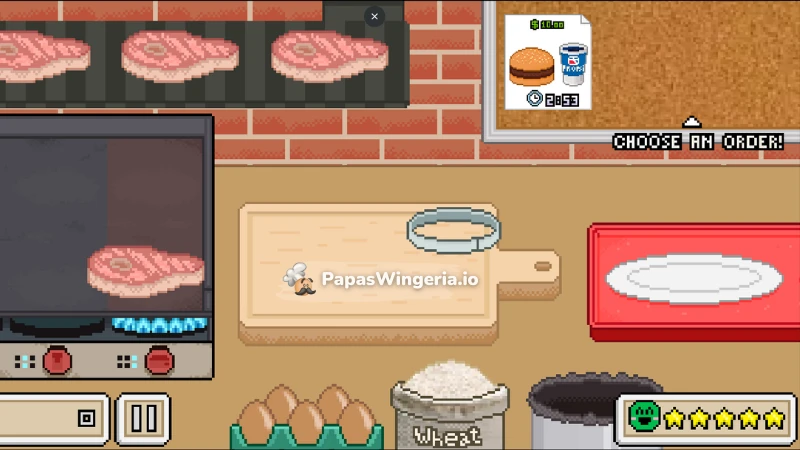
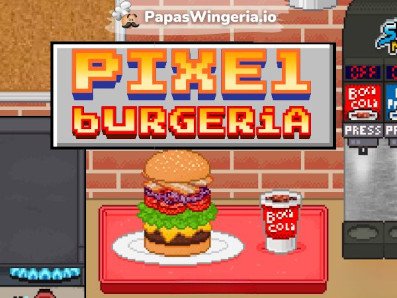
When it comes to food games, there are lots of titles resembling each other. So we had to focus on originality. And trust me, Pixel Burgeria is a very original game that takes the cooking simulation into indie territory with its retro visuals and puzzle-like mechanics. Instead of trying to be realistic, it leans into the charm of pixel graphics. You need to create your own ingredients by solving little puzzles. You need a patty for your burger? First you should find some meat and a knife in your kitchen to mince it. What makes it stand out is the way each order feels like solving a pixel puzzle. The game is about placement and sequence. Even though controls might feel laggy sometimes, it’s still a great example of how cooking games can be reimagined through a creative aesthetic lens.
8. Toka World Restaurant
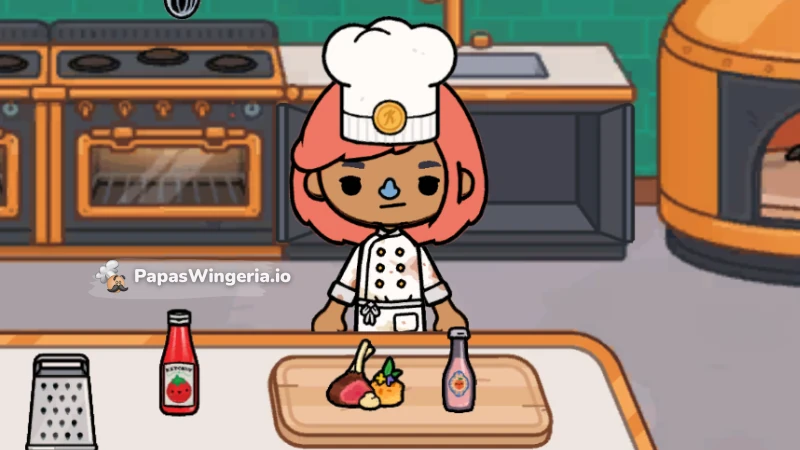
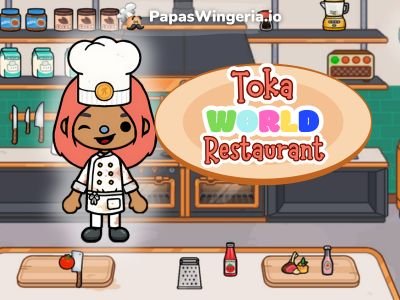
Toka World Restaurant was aimed at a younger audience at first. But its appeal crosses over because of how open-ended it feels. Rather than strict levels, it gives you freedom to play with food, decorate your own restaurant, create food themed scenarios in all ways possible. There's no reward or penalty system. So this creates a flexibility making it more like a cooking sandbox than a restaurant sim.
9. Pizzeria For Kids
Unlike most kids’ cooking games, Pizzeria for Kids sneaks in a bit of learning by walking players through real recipe steps. It’s not about introducing cooking basics like kneading dough, adding toppings, baking until golden. Many parents use it as a playful introduction to how pizza is actually made. That mix of fun and real-world learning gives it staying power for young audiences. And adults! Don't read those long boring pizza recipes. Play this game instead and you'll not miss any steps while making your own pizza in real life. That's how educational this game.
10. Smurfs Cooking
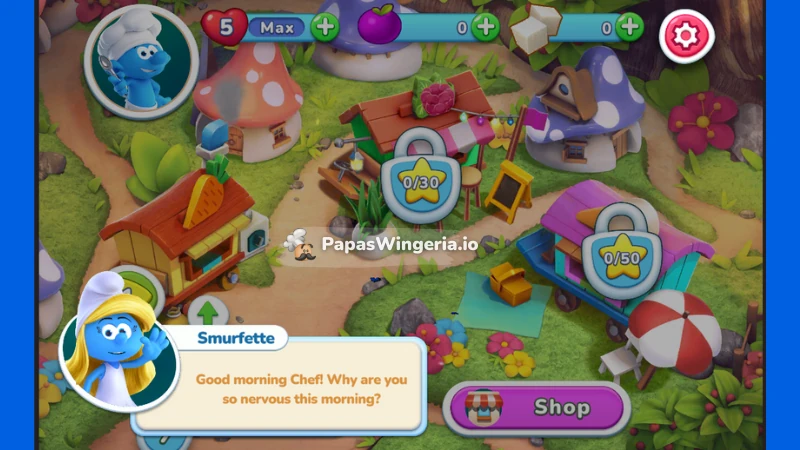
Our favorite characters from our childhood now on our mobile screens. Smurfs Cooking is a licensed game by Peyo. I admit it has very slow pace at the beginning. That's why I put it as a last item on my list. But after a while, you'll be captivated by its pace, various cooking and serving mechanics. The recognizable world of Smurf Village adds a narrative layer as serving food to your favorite Smurfs feels more personal than any anonymous customer. It’s a clever blend of franchise comfort and gameplay depth.
The Takeaway: Food, Play, and Human Connection
Cooking games may look lighthearted, but they’ve proven to be much more than casual clicks on a screen. From their arcade beginnings to the Flash era boom, and now the mobile-first HTML5 revival, they’ve evolved alongside technology. It happened all while keeping the same simple promise of turning food into play. The genre has split into two paths: fast-paced time management for those who like pressure, and cozy spaces for players seeking comfort. At the same time, research and psychology show that the appeal of cooking games runs deeper. They echo the routines, creativity, and satisfaction of real cooking, offering players a way to experiment, succeed, or just relax for a few minutes.
As the cozy gaming trend grows, it’s clear that food games will keep adapting. Whether by teaching real recipes, simulating restaurant chaos, or creating slow, shareable moments perfect for a quiet evening. What started as pixelated burgers in the arcade now stretches into research labs, indie studios, and social feeds. Cooking games online aren’t just a niche they’ve become a mirror of how we play, relax, and even understand food itself in the digital age. If you need a safe place that delicately curates best cooking games to play online, bookmark PapasWingeria.io and you'll never regret it. Have fun cooking!
References
- Manera, V., Petit, P.-D., Derreumaux, A., Orvieto, I., Romagnoli, M., Lyttle, G., David, R., & Robert, P. H. (2015). ‘Kitchen and cooking,’ a serious game for mild cognitive impairment and Alzheimer’s disease: A pilot study. Frontiers in Aging Neuroscience, 7, 24. https://doi.org/10.3389/fnagi.2015.00024
- Livert, D. (2023). A Psychology of Food, Cooks, and Cooking. Lexington Books / Rowman & Littlefield.